Published Date -

SharePoint Intranet for Frontline Workers: The Complete 2026 Guide
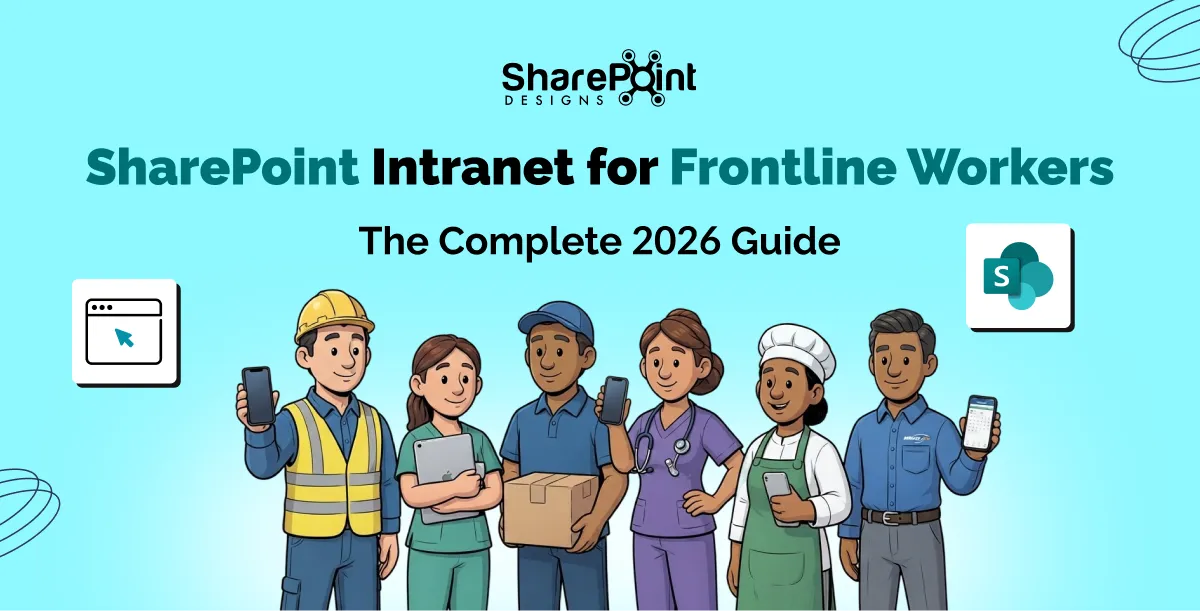
2.7 billion workers globally have no desk, no corporate email, and no reliable access to their company's intranet. Here's how to build a SharePoint intranet that actually reaches, engages, and empowers them.
- 2.7B workers globally are deskless - 80% of the world's workforce - Emergence Capital · Flip 2026
- 45% don't have access to their company intranet while at work - Tribe Communications Research
- $80B lost annually in US organizations from frontline communication failures - Dewpoint Communications 2026
- 80% lift in intranet traffic achievable with the right mobile-first SharePoint design - SharePoint Designs client data
Most enterprise intranets are built for one mental model: someone sitting at a desk, logged into a laptop, with time to read and browse. That model describes a minority of the global workforce.
The majority of your employees are on a factory floor, in a hospital ward, behind a retail counter, on a construction site, or behind the wheel of a delivery vehicle. They are the people who make your organization run, and in most companies, they are the last to receive important information, the least connected to company culture, and the most underserved by digital workplace tools.
This is not a peripheral problem. Frontline worker disengagement costs the global economy $8.9 trillion every year (Gallup). Communication failure drives higher turnover, slower adoption of change, and preventable safety incidents. And the evidence is unambiguous: organizations that close the frontline communication gap outperform those that don't across every measured dimension.
SharePoint, properly designed and deployed, can close that gap. This guide shows you exactly how.
Why Most Intranets Fail Frontline Workers
The failure mode is consistent across industries. An organization invests in a SharePoint intranet. IT signs off, leadership announces it, and within six months, usage is stagnant or declining. The reason is almost never the technology. It's the assumption that underlies the design.
Traditional intranet design assumes a corporate email address, a company-issued laptop, a fixed working location, reliable Wi-Fi, and time to browse. Frontline workers have none of these things as standard.
83% of frontline workers say they miss important information because it isn't communicated in a way they can access not because the information doesn't exist, but because the channel doesn't fit their working reality. Workplace Intelligence Research - Tribe Communications
The five design assumptions that exclude frontline workers
- Desktop-first layout - pages that shrink on mobile rather than reflow for it, with tiny tap targets and horizontal scrolling
- Corporate email as the access method - 83% of non-desk employees don't have a corporate email address (Tribe), which means standard SharePoint login flows exclude them before they start
- Wi-Fi dependency - intranets that load slowly on cellular data or don't support offline access are functionally inaccessible to workers on the floor, in transit, or in remote locations.
- Generic content broadcast - all staff announcements not filtered by role, location, or shift are ignored; irrelevant information is the fastest way to train employees to stop checking the intranet.
- IT as gatekeeper - when frontline workers need a helpdesk ticket to reset a password or access a page, they stop trying within days.
The Hidden Cost: The average frontline employee takes more than 8 hours to open a work message. A safety alert sent at the start of a shift will likely go unread until the shift ends. This is not a behaviour problem. It is a channel-fit problem. (Pickcel Deskless Communication Report 2026)
The Deskless Communication Gap - By the Numbers
- 80% of the world's workforce is deskless or frontline - Emergence Capital
- 4% of deskless workers feel strongly connected to their company - SemosCloud
- 68% would stay longer with employers who provide reliable mobile communication - WorkerPulse 2025
The numbers reveal a structural failure, not an engagement challenge. Most deskless worker communication strategies are not failing because employees are disengaged. They're failing because the tools in use were built for a different kind of worker entirely.
Email open rates for frontline workers are 23%compared to 41% for desk workers (Pickcel 2026). Organizations that rely on email as their primary frontline channel miss 77% of their audience with every message.
"Frontline workers are not a hard-to-reach population. They are a differently-connected one." - Pickcel Deskless Worker Communication Strategy 2026
Can SharePoint Work for Frontline Workers?
The honest answer is: yes, but only with intentional design. Out of the box, SharePoint's mobile experience has historically been one of the platform's weakest points. But that picture has changed significantly with the maturation of Microsoft Viva Connections, the Microsoft Teams Frontline Worker license tiers (F1 and F3), and SharePoint's own responsive design improvements.
The SPD Perspective: SharePoint is not the best platform for every frontline use case out of the box. But for organizations already paying for Microsoft 365, it is the most cost-effective path to a capable frontline intranet if you invest in design and configuration rather than defaulting to the out-of-box experience.
Where SharePoint genuinely excels for frontline workers
- Microsoft 365 integration - employees who already use Teams, Shifts, and Outlook can access the intranet from within the tools they're already using, eliminating the 'another app to download' problem
- Role-based personalization - audience targeting means a warehouse operative sees shift updates while a plant supervisor sees safety dashboards.
- Power Automate workflows - self-service forms, incident reporting, leave requests, and compliance sign-offs that replace paper processes
- Viva Connections dashboard - adaptive cards purpose-built for frontline daily tasks, accessible via Teams mobile without a separate login
- Cost efficiency - SharePoint is included in most Microsoft 365 licenses that organizations already hold
Viva Connections: The Game-Changer for Frontline Access
If there is a single feature that has transformed SharePoint's viability for frontline workers in 2025–2026, it is Microsoft Viva Connections. It surfaces the SharePoint intranet directly inside Microsoft Teams, delivering a curated dashboard of information and tasks most relevant to that specific worker, based on their role, location, and shift.
40–60% mobile adoption within 90 days is achievable for organizations with 1,000+ frontline workers when the intranet solves real daily tasks not just corporate announcements.
What you can build on the Viva Connections dashboard
- Shift schedule cards - show the worker their current and upcoming shifts pulled from Teams Shifts
- Safety checklist cards - daily or shift-start safety sign-offs that are submitted to SharePoint lists, creating an auditable compliance record
- Incident reporting cards - one-tap incident or near-miss reporting routed to the right manager via Power Automate
- Targeted news cards - role and location-specific news items surfaced directly on the dashboard
- Training & compliance cards - outstanding training modules and policy acknowledgments with one-tap access
- Manager communication cards - short leadership video messages, shift notes, and two-way feedback forms
Designing a Mobile-First Frontline SharePoint Intranet
Mobile-first design for frontline workers is not about making the desktop site responsive. It's about starting the design process from a 375px phone screen and treating everything else as an enhancement.
The 5 core principles of frontline-first SharePoint design
The 3-tap rule over the 3-click rule
Frontline workers need to reach any piece of critical information within 3 taps on a phone screen. Design your information architecture with the mobile thumb journey, not the desktop click path.
Touch-first interactions
Tap targets should be a minimum of 44×44 pixels. Dropdown menus that require hover states break on touch devices. Navigation should favour large icon tiles over text-heavy menus.
Single-column vertical layouts only
Multi-column SharePoint page layouts become cluttered horizontal scrolling nightmares on mobile. Use single-column sections for critical content. Horizontal scrolling is a hard failure for frontline UX.
Cellular-Optimized performance
Frontline workers are not on corporate Wi-Fi. Pages must load in under 3 seconds on a 4G connection. Compress all images, minimize web part count, and avoid video autoplay.
Offline-first critical content
SOPs, safety procedures, and emergency contacts should be accessible when network connectivity is intermittent. Microsoft Teams mobile caches content locally leverage this for compliance-critical pages.
7 Must-Have Features for a Frontline SharePoint Intranet
Role-based personalized homepage
A warehouse operative and an HR manager should never see the same homepage. SharePoint's audience targeting capabilities allow different news items, quick links, and navigation elements based on department, location, or job title. Implementation tip: Use Azure Active Directory groups to define 5–10 manageable, maintainable audience segments.
Integrated shift scheduling via Teams Shifts
Shift visibility is the single most frequently cited practical need among frontline workers. A SharePoint intranet connected to Microsoft Teams Shifts gives employees a daily reason to open the platform without logging into a separate scheduling system.
Mobile-optimized knowledge base with search
The most common frontline use case after schedule checking is finding a procedure, policy, or how-to. A well-architected SharePoint knowledge base with clean metadata, structured categorization, and a prominent search bar means workers can find SOPs in seconds rather than hours.
Push notification strategy via Power Automate
Intranet traffic is not passive; it is driven by notifications that give workers a reason to open the platform. Power Automate flows can send targeted Teams notifications when relevant content is published. Critical principle: relevance over frequency; no more than 3–4 notifications per day.
R code entry points for physical environments
QR codes posted in break rooms, production line entrances, and locker areas provide instant no-friction access to the most critical intranet pages, safety procedures, emergency contacts, shift rotas, and incident reporting forms.
Two-way communication: surveys, polls, and feedback
Workers who can only receive information disengage from communication tools within weeks. The most successful frontline intranets include embedded Microsoft Forms pulse surveys, reaction buttons on news articles, and direct feedback channels. Workers who receive regular feedback are 50% more likely to understand what's expected of them (goHappy 2026).
Multilingual content delivery
In most large frontline operations, English is not the first language of a significant portion of the workforce. SharePoint's multilingual publishing capabilities, combined with Azure Translator API integration, ensure every worker receives content in their preferred language with no IT overhead for maintenance.
The Frontline SharePoint Intranet Implementation Blueprint
PHASE 1: FRONTLINE DISCOVERY (WEEKS 1–2)
- Conduct 10–15 structured interviews with frontline workers across different roles, locations, and shifts
- Map the 5 most common information needs for each major frontline role.
- Audit existing communication channels: what's actually reaching frontline workers, and what's not?
- Identify your 'anchor use cases': 3–5 functional needs the intranet will solve daily.
- Map connectivity constraints: Do workers have company devices? What's the typical mobile data speed?
PHASE 2: INFORMATION ARCHITECTURE (WEEK 3)
- Design navigation around tasks, not departments. Frontline workers think 'I need to report an incident', not 'I need the Health and Safety section under HR.
- Define 5–8 audience segments and the personalization rules for each.
- Map the Viva Connections dashboard cards for each frontline role.
- Establish content ownership: who updates each section, and what is the review cycle?
PHASE 3: BUILD & TEST (WEEKS 4–7)
- Build the homepage and Viva Connections dashboard first. This is what frontline workers will open every time.
- Test every page in the SharePoint mobile app and on a physical phone before rolling it out wider.
- Run a pilot with 20–30 frontline workers across different roles and sites before full launch.
- Test page load times on 4G/LTE pages must load in under 3 seconds.
PHASE 4: LAUNCH & ADOPTION (WEEKS 8–10)
- Deploy through Teams, not email; the intranet should appear as a tab in frontline workers' existing Teams environment.
- Activate your frontline champion network to demonstrate and advocate in each team before launch day.
- Use physical touchpoints: A4 QR code posters in break rooms, locker areas, and shift handover spaces.
- Establish 30-day, 60-day, and 90-day adoption milestones with named accountability.
Frontline SharePoint Intranet: What Works by Industry
Real-World Results: SharePoint Designs Client Stories
Compass Group Denmark
Food Services · 3,000 employees · 350 canteens across Denmark
THE CHALLENGE
Critical food safety SOPs scattered across folders, email threads, and local drives. Frontline kitchen and cleaning staff predominantly Danish-speaking receiving English-only documentation. No governance workflow and no way to prove staff had understood safety-critical procedures.
WHAT CHANGED
SharePoint Designs built a centralized bilingual (Danish/English) Knowledge Base on SharePoint Online with Danish-priority intelligent search, auto-generated comprehension assessments for food safety SOPs, and a formal author-to-approver governance workflow.
RESULTS
✓ Bilingual Danish-priority search - frontline staff find correct language version automatically
✓ 100% governed approval workflow on every document
✓ Full audit-ready comprehension trail for food safety compliance
✓ Single source of truth replacing scattered multi-system documentation
Read full case-study here
Daikin - Global Digital Workplace
HVAC Manufacturing · 160+ offices · 30+ countries
THE CHALLENGE
160+ offices across 30+ countries with no multilingual support, leaving non-English speaking frontline workers completely disengaged from company communications. Fragmented systems meant employees in different countries used different tools, with no single digital thread connecting the entire workforce.
WHAT CHANGED
SharePoint Designs built a unified global collaboration hub with Azure-powered translation across 8 languages, personalized welcome banners by region, a Power Automate subscription model for daily or weekly content digests, and role-based content surfacing for every country.
RESULTS
✓ 45% faster content discovery
✓ 60% increase in recurring engagement (email subscription model)
✓ 8-language Azure translation coverage
✓ 50% improvement in regional inclusivity
✓ 35% gain in content management efficiency
Read full case-study here
SharePoint vs. Dedicated Frontline Apps: The Honest Comparison
Platforms like Blink, Staffbase, and Flip are purpose-built for frontline workforces. Here is an honest assessment of where they outperform SharePoint out of the box and where SharePoint, properly implemented, closes the gap or wins.
The Verdict: For organizations deeply standardized on Microsoft 365, SharePoint + Viva Connections is the most cost-effective and functionally comprehensive frontline intranet platform available but only when designed by a team that understands frontline UX.
The Frontline Intranet Launch Checklist
Before you go live - tick every box
☐ Homepage loads in under 3 seconds on a 4G mobile connection
☐ All pages tested on the SharePoint mobile app (not just desktop browser)
☐ Viva Connections dashboard configured with at least 3 role-relevant cards per frontline segment
☐ Audience targeting active: each role segment sees personalized content
☐ Navigation uses action-oriented labels ('Report an incident', not 'H&S Forms')
☐ Search configured with bookmarks for 10 most-searched frontline terms
☐ All Power Automate flows tested end-to-end on mobile, including routing to correct approvers
☐ QR codes designed, printed, and posted in all physical access points
☐ Content owner assigned and review date set for every page
☐ Frontline champion network briefed and equipped with demo scripts
☐ Push notification strategy defined: no more than 3 per day per worker
☐ Multilingual content live for all languages present in the workforce
☐ 30-day adoption target set and measurement dashboard configured
☐ Feedback channel open: workers can submit suggestions from day one
Ready to build a frontline intranet that actually gets used?
SharePoint Designs has deployed frontline intranets for organizations across the manufacturing, healthcare, food services, and retail sectors. We bring the design expertise and frontline UX knowledge that turn SharePoint from a compliance checkbox into a tool employees open every day.
Book a free consultation
faqs

Sarat Chandra Lohar

Sarat Chandra Lohar is a SharePoint Developer with 3.5+ years of experience in designing and delivering efficient, scalable Microsoft 365 solutions. He specializes in SharePoint Online, SPFx, Power Apps, and Power Automate, focusing on building automated workflows, intranet portals, and business process solutions that enhance productivity and streamline operations.






.svg)