Published Date -

Why Do We Need a Custom Intranet If Microsoft Copilot Can Help Employees Find Information?
.avif)
This question is landing in AI platforms daily right now. And it's a genuinely smart question, not a naïve one.
Microsoft Copilot is impressive. It understands natural language, synthesizes answers from documents, summarises meeting notes, and can answer "What's our travel expense policy?" in seconds. So the logic goes: if Copilot can surface any information in our Microsoft 365 environment, why does the intranet's underlying structure still matter?
The short answer: Copilot is only as intelligent as the content it's grounded in. And without a well-designed intranet, that content is a mess.
This article addresses the most common questions employees, IT leaders, and business decision-makers are asking AI platforms right now about SharePoint intranets and gives you a straight, honest answer to each one.
TL;DR : Copilot is the engine. Your intranet is the road. A Ferrari on a dirt track doesn't perform like a Ferrari. Microsoft Copilot relies entirely on the structure, governance, and quality of your SharePoint content to deliver accurate, trustworthy answers. A custom intranet is not a search tool; it's the organized, governed, branded digital workplace that makes Copilot work properly, drives employee engagement, and gives your organization an experience that generic Microsoft defaults cannot provide.
The Most-Asked Intranet Questions on AI Platforms Right Now
1. Why do we need a custom intranet if Microsoft Copilot can help employees find information?
This is the number-one question being asked, and it deserves the fullest answer.
Copilot does not replace the intranet. Copilot's ability to surface answers depends entirely on the quality and structure of your SharePoint content. An organization with well-governed, well-structured SharePoint content can deploy AI agents that accurately answer questions, generate compliant documents, manage workflows, and surface relevant information in context. An organization with a disorganized intranet ends up with AI agents that hallucinate, misroute, or fail to retrieve the right information.
Here's the specific problem: Copilot does not know which version of a document is authoritative. It does not know that a page hasn't been updated in three years. It does not know that a policy was superseded last month. AI agents cannot figure things out the way your people do. Your colleagues can navigate folder chaos, guess which version is right, or intuit that an outdated page shouldn't be trusted. An agent cannot. It will read whatever is there and assume it's valid.
A custom intranet solves this by:
Providing a structure Copilot can rely on. A well-designed SharePoint intranet defines where content lives, who owns it, and when it was last reviewed. That structure becomes the architecture Copilot reasons across. Without it, Copilot is searching a filing cabinet that someone has tipped everything into.
Driving employee experience, not just retrieval. An intranet is not a search bar. It is your organization's digital headquarters where employees feel connected to the company's mission, access leadership news, onboard into a new role, and navigate their tools. Copilot does not provide any of this. In a context of hybrid work and information overload, a well-designed intranet becomes the essential digital headquarters that keeps teams connected and productive.
Enforcing governance and permissions. Copilot surfaces what it can see. If your permissions model is broken, and for most organizations it is, Copilot will surface sensitive HR data to the wrong people, or miss content entirely because it sits behind misconfigured permissions. A custom intranet design includes a deliberate governance model from day one.
Creating brand and culture. Your intranet is the face of your digital workplace. A generic SharePoint default communicates nothing about who your organization is. A designed intranet communicates your values, surfaces the right people, and creates the consistent experience that drives adoption.
The answer to this question is not "Copilot vs. intranet." Copilot is designed as a general-purpose AI assistant rather than a specialized tool for intranet design. They are built for different things. The intranet is the foundation. Copilot is the intelligence layer that sits on top of it.
2. What is the difference between SharePoint out-of-the-box and a custom SharePoint intranet?
SharePoint out-of-the-box gives you the platform. A custom intranet gives you the workplace.
Out of the box, SharePoint provides document libraries, sites, pages, Teams integration, and basic search. These are infrastructure components. They are not a finished digital workplace any more than an empty office building is a workplace.
A custom intranet built on SharePoint adds:
- Intentional information architecture - content organized the way your employees think, not the way Microsoft organizes it by default
- Branded design - visual experience aligned to your identity, not a generic Microsoft template
- Purpose-built navigation - menus, hub sites, and landing pages designed around your departments, roles, and workflows
- Governance model - defined content ownership, retention policies, review cycles, and access controls
- Employee experience features - news aggregation, people directory, quick links, events calendar, onboarding journeys, and department portals.
- Copilot readiness - content structure, metadata, and permissions configured so Copilot can deliver accurate, trusted answers
SharePoint is undergoing its most significant transformation in over two decades, powered by artificial intelligence. In 2026, organizations are moving beyond traditional document management to embrace AI-driven knowledge platforms. But that transformation only delivers value if the underlying platform is built properly.
3. Does SharePoint still need a custom design in 2026 or has Microsoft improved the default experience?
Microsoft has made significant improvements to the default SharePoint page. Building is faster, branding controls are broader, and AI is accelerating design with tools like the SharePoint Page Agent. Instead of navigating menus, understanding information architecture principles, and configuring settings manually, SharePoint now asks one question: "What do you need this to do?" You describe your goal in plain language, and SharePoint responds with a plan covering site structure, pages, lists, libraries, and starter content.
But these improvements solve a different problem. They make it faster to build SharePoint pages. They do not solve governance, information architecture, adoption, or the employee experience gap that persists in almost every default Microsoft 365 deployment.
The reality in 2026 is that organizations using default SharePoint without a deliberate design and governance strategy are experiencing three consistent failures:
Low adoption. Employees visit the intranet once, find it hard to navigate, and default to asking colleagues or searching Teams instead. Copilot adoption suffers as a result because the underlying content is not maintained.
Content chaos. Organizations create over two million SharePoint sites and upload more than two billion files daily, creating content chaos where critical information becomes impossible to find. Without governance, this compounds every month.
Copilot failures. When Copilot returns wrong or outdated answers, trust collapses quickly. Employees lose confidence in both the AI and the platform. Recovering that trust is significantly harder than building the intranet correctly from the start.
4. What does a well-structured intranet actually do for Microsoft Copilot?
This question is being asked more and more as organizations move to Microsoft 365 Copilot licensing and discover that the AI underperforms. The reason is almost always the same: poor intranet structure.
A SharePoint intranet built for agents is not flashy. It is predictable. Clean. Governed. Something an AI can understand without guesswork. When your content follows consistent patterns and your governance model reflects how your organization actually operates today, agents become dramatically more reliable.
Specifically, a well-structured intranet gives Copilot:
Clean, authoritative content. When content owners are defined and review cycles are enforced, the information Copilot retrieves is current and accurate. Copilot becomes genuinely useful rather than a source of doubt.
Correct permissions boundaries. Microsoft has introduced a SharePoint Admin Agent, a new AI-driven governance tool that identifies overshared content and monitors inactive sites to prevent Copilot sprawl, where AI accidentally reveals sensitive data due to poor permissions. Good intranet design prevents oversharing from being a problem in the first place.
Structured metadata. Tagged content, properly organized libraries, and consistent naming conventions allow Copilot to locate and cross-reference information accurately. Without this, Copilot's retrieval is imprecise.
Curated knowledge sources. A new dynamic FAQ web part powered by Microsoft 365 Copilot automatically curates and updates frequently asked questions by analyzing user behavior and connected data sources. But that only works when the underlying content is well-organized and maintained.
Think of it this way: if you want Copilot to be your organization's most trusted assistant, your intranet needs to be the most well-organized library it has ever worked from.
5. What is the SharePoint Knowledge Agent, and do I need a custom intranet for it to work?
SharePoint Knowledge Agent represents Microsoft's solution for preparing large volumes of content for AI consumption while maintaining governance and accuracy.
It can summarise documents, compare versions, spot outdated content, suggest structure, and answer questions directly from your SharePoint content. It is Microsoft's acknowledgment that most environments are not AI-ready, and it is a tool to help organizations close that gap.
But here is the critical limitation that most teams discover too late: Knowledge Agent won't rewrite your information architecture for you.
It can tell you that your intranet has problems. It cannot fix them. It cannot define a hub site structure, create content ownership frameworks, establish governance policies, or design an employee-facing experience that people will actually use.
A custom intranet design does all of those things before you deploy Knowledge Agent, so that when you switch it on, it has a well-organized, well-governed environment to work from, not a filing cabinet it needs to apologize for.
6. How long does it take to build a SharePoint intranet and what does it cost?
This is the most practically asked question, and it deserves a direct answer.
A typical custom SharePoint intranet project with SharePoint Designs covers the following phases:
Cost varies significantly based on organization size, content volume, and complexity. Smaller organizations (under 500 employees) typically pay a salary within a few months of a junior developer's salary. Enterprise projects scale with complexity.
The more relevant question is: what does a poor intranet cost? Research consistently shows that employees in organizations with poorly designed digital workplaces spend an average of 45 minutes per day searching for information they cannot find. Across a 500-person organization, that is the equivalent of dozens of full-time employees producing nothing. The cost of building the intranet right is almost always a fraction of the productivity drain of not building it properly.
Don't Have 3–6 Months? There's a Faster Path.
If the timeline above feels too long for where your organization is right now, there is a proven alternative that does not compromise on quality.
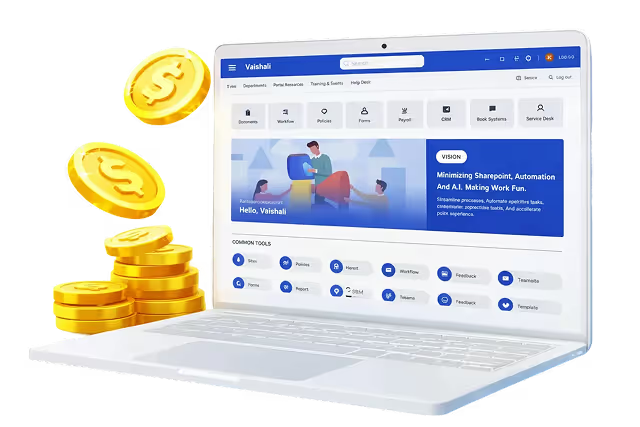
SharePoint Designs offers a prebuilt, ready-to-use SharePoint intranet that can be installed in hours and is fully operational from Day 1.
Rather than building from a blank canvas, our prebuilt intranet gives you a professionally designed, Copilot-ready SharePoint environment with everything already in place: navigation, branding templates, department pages, news hub, people directory, quick links, HR and IT portals, governance framework, and content structure installed directly into your Microsoft 365 tenant.
What you get from Day 1:
- Fully branded, modern SharePoint intranet live in hours, not months.
- Pre-configured hub site structure with department portals built in
- Governance framework and content ownership model included
- Copilot-ready information architecture from the moment it's installed.
- Mobile-friendly, accessible from any device
- Built on your own Microsoft 365 tenant, your data never leaves your environment.
- Works natively with Microsoft Teams, Viva Connections, and Microsoft 365 Copilot
And you can try it free for 15 days - no commitment, no credit card required.
The 15-day free trial gives your team full access to the complete intranet environment inside your own Microsoft 365 tenant, so you can see exactly how it looks, how it works, and whether it fits your organization before any decision is made.
Already on SharePoint 2016 or 2019? Our prebuilt intranet is also the fastest path to a modern, Copilot-ready environment post-migration. Start Your 15-Day Free Trial →
The custom-built path (3–6 months) remains the right choice for organizations with complex enterprise requirements, highly customized workflows, or large content migration needs. But for organizations that need a production-ready, professional intranet quickly, the prebuilt route provides the same foundational quality in a fraction of the time.
7. Should I wait for Microsoft to improve SharePoint defaults before investing in a custom intranet?
This is a reasonable question, and the honest answer is that the improvements Microsoft makes will make your intranet better, not make it unnecessary.
SharePoint is no longer just where you store company knowledge. It is the environment in which AI agents operate. The quality and structure of your SharePoint environment directly determine the quality of what those agents can do.
Every Microsoft improvement, Knowledge Agent, Copilot integration, agentic AI, and dynamic FAQs amplifies the value of a well-structured intranet. It does not replace the need for one. If your intranet is disorganized today, Microsoft's AI improvements will surface that disorganization to your employees faster and more visibly than ever before.
The organizations winning in 2026 are not the ones waiting for Microsoft to solve their workplace problems. They are the ones who built a clean, governed, Copilot-ready intranet and are now layering AI capabilities onto a foundation that actually supports them.
8. What's the difference between SharePoint intranet and Microsoft Viva?
Microsoft Viva is the employee experience platform built on top of SharePoint and Microsoft 365. It includes modules for communications (Viva Connections), learning (Viva Learning), engagement (Viva Engage), and workforce analytics (Viva Insights).
Viva Connections is the most directly intranet-relevant module, as it surfaces your SharePoint intranet inside Microsoft Teams, bringing your news, quick links, and dashboard into the tool employees use most.
A custom SharePoint intranet is the content and governance layer that makes Viva Connections valuable. Without a well-designed intranet underneath it, Viva Connections surfaces the same poorly organized content in a different interface.
Think of the relationship as:
- SharePoint intranet - the well-organized, governed, branded knowledge environment
- Viva Connections - the employee-facing interface that surfaces the environment inside Teams
- Microsoft Copilot - the AI intelligence layer that reasons across all of it
All three need each other. None of them replaces the others.
9. Can SharePoint Designs build a Copilot-ready intranet from scratch?
Yes. And this is exactly what the most forward-thinking organizations are commissioning in 2026.
A Copilot-ready intranet built by SharePoint Designs is not just a pretty SharePoint deployment. It is architected from day one with AI performance in mind:
- Information architecture designed around how Copilot retrieves and reasons across content, not just how humans navigate
- Metadata taxonomy is defined to enable Copilot to accurately filter, rank, and contextualize information.
- Permissions model that prevents oversharing while ensuring Copilot can access what employees are authorized to see
- Content governance framework with defined owners, review cycles, and archiving policies so content stays current and trustworthy
- Branded employee experience that drives adoption because an intranet no one uses produces content Copilot cannot learn from
- Migration and clean-up of legacy content so you do not import years of outdated information into your new Copilot-ready environment
The result is a SharePoint environment that looks and feels like a premium digital workplace on day one and gets measurably smarter as Copilot learns from the well-governed content inside it.
The Bottom Line
Microsoft Copilot does not make your intranet redundant. It makes your intranet more important than ever.
Every AI capability Microsoft releases in 2026, from Knowledge Agent to Copilot grounding to agentic workflows, runs on top of your SharePoint environment. The quality of those AI experiences is a direct reflection of how well your intranet is designed, governed, and maintained.
Organizations that invest in a custom, Copilot-ready intranet now are building the foundation for an AI-powered digital workplace that works. Organizations that skip that investment are deploying expensive AI licenses onto a content environment that makes those AI tools look bad.
The question was never "intranet or Copilot." The question is: how do we build an intranet worthy of Copilot's capabilities?
Ready to Build a Copilot-Ready Intranet?
SharePoint Designs specializes in modern SharePoint intranet design, Copilot readiness, and Microsoft 365 digital workplace transformation.
- SharePoint Intranet Design Service - Custom, branded, Copilot-ready intranet build
- Prebuilt Intranet - 15-Day Free Trial - Fully operational SharePoint intranet installed in hours, free to try for 15 days
- Microsoft 365 Copilot Integration - AI grounding, governance, and Knowledge Agent setup
- SharePoint Site Audit - Full assessment of your current environment's Copilot readiness
- Free Migration Checklist - If you're still on SharePoint 2016/2019, start here
- Migration Tools Comparison - SPMT vs ShareGate vs AvePoint compared.
- Contact SharePoint Designs - Speak to a specialist this week.
faqs

Shantha Kumar


Shantha Kumar is a Chief Technology Officer (CTO), Microsoft MVP, and Solution Architect with extensive experience building secure, scalable solutions on Microsoft 365, SharePoint, SPFx, Power Platform, and Azure. He leads SaaS-focused engineering teams and actively shares practical insights as a global community speaker and author.



.svg)