Published Date -

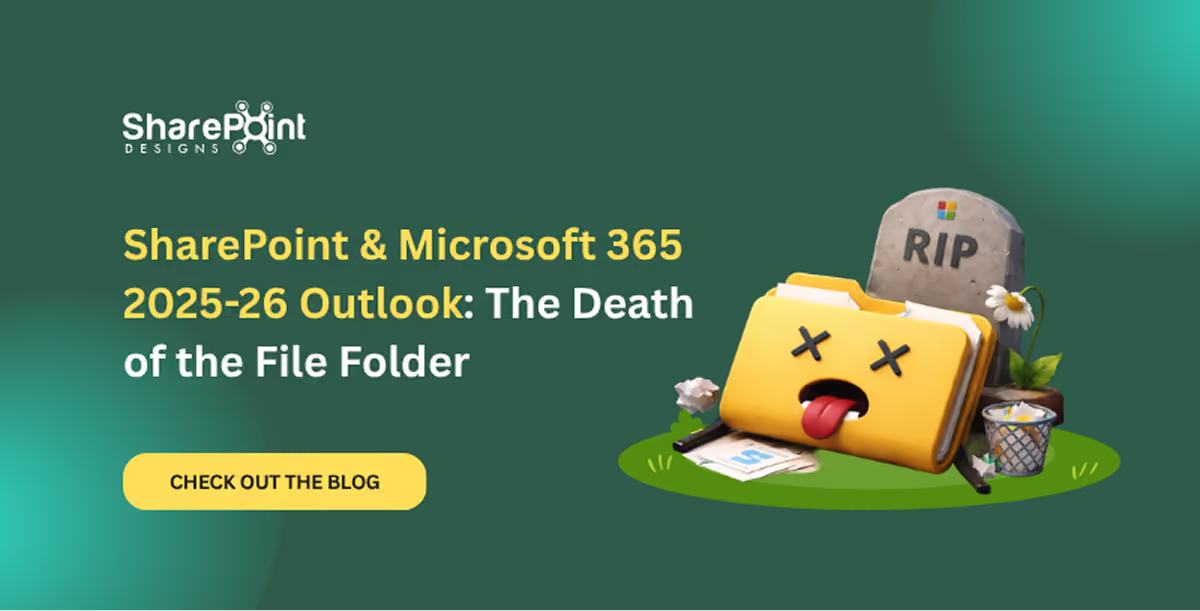
SharePoint & Microsoft 365 2025–26 Outlook: The Death of the File Folder
SharePoint is moving beyond libraries, folders, and permissions. Microsoft is building an intelligent content platform where AI agents handle documents, letting you focus on meaningful work. Here’s what IT leaders and intranet owners must know for 2025-2026.
The Copilot Era Isn't Coming. It's Already Here.
Let's start with the biggest shift. Microsoft 365 Copilot, now an AI-powered assistant across Word, Excel, PowerPoint, Teams, and SharePoint, has moved from blog post previews to full production. But 2025's story isn't about Copilot itself. It's about what happens when Copilot gets specialized.
Copilot Agents (Agent 365)
Think of these as dedicated AI employees for each SharePoint site. A legal site might have an agent trained on contract templates and regulatory filings. An HR portal could have one that answers benefits questions using your company's actual policy documents. These are not generic chatbots. They are site-specific AI assistants that understand your content.
Agentic Workflows
This is where automation becomes autonomy. An agentic workflow (an automated process managed by AI systems rather than just following preset steps) does more than move a document from folder A to folder B when you click "Approve." It reads the document, finds which approval chain is required, routes it, follows up with stalled approvers, and escalates when deadlines pass. The human stays in the loop but no longer deals with the plumbing.
Key distinction: Traditional Power Automate flows (Microsoft’s service for automating repetitive tasks) follow rigid IF-THEN rules. Agentic workflows use AI reasoning (artificial intelligence logic that can adapt to exceptions) to handle edge cases that would have previously required a human to intervene.
Work IQ and Semantic Search
Work IQ is Microsoft's name for the contextual intelligence layer across your entire M365 tenant. It knows which files you've worked on, which meetings discussed a topic, and which emails are project-related, even if nobody tagged them properly.
The result is semantic search. Instead of searching for "Q3-budget-final-v2-REVISED.xlsx," you search for "the budget spreadsheet Sarah shared after the board meeting." The system understands your intent, matches it to your activity graph, and surfaces the right file. This saves knowledge workers hours each week. It reduces the time spent finding things to 20%.
AI Meeting Summaries
Teams meetings now generate structured summaries. These are not just transcripts, but distilled outputs: decisions made, action items assigned, and questions left open. Summaries are automatically stored as team SharePoint documents, creating a searchable decision log that did not exist before.
SharePoint Premium: Your Documents Learn to Read Themselves
SharePoint Premium (formerly Syntex) is Microsoft's answer to a common problem. Every organization has mountains of unstructured content that no one can find, classify, or govern at scale. The 2025–2026 updates push SharePoint Premium from an "interesting add-on" to strategic infrastructure.
Content Assembly
Imagine you have a SharePoint list with 200 rows of client data. Content Assembly lets you create a Word or PDF template, such as a consulting agreement. You can auto-generate 200 personalized documents in minutes. No mail merge and no manual copy-paste. The templates are modern, using structured content controls rather than legacy fields. The output is clean, branded, and ready to send.
For any organization that generates contracts, proposals, or compliance reports at volume, this capability alone justifies the Premium license.
Taxonomy Tagging
Here's the dirty truth about metadata: everyone agrees it is important. Nobody wants to do it manually. SharePoint Premium solves this with AI-driven auto-tagging. Upload a document, and the system reads it and matches its content to your organization's term store. It automatically applies the right tags.
The accuracy is not perfect on day one, but the model improves as it processes more content. The real value is consistency. Instead of 50 people tagging documents 50 different ways (or not tagging them at all), you get a single, enforced taxonomy across the organization.
Why does this matter for intranets :Taxonomy tagging is the foundation for metadata-driven navigation. Without clean, consistent tags, your smart intranet filters are just empty dropdowns. With good tags, employees find what they need in seconds.
Unstructured Document Processing and OCR
Not every document in your company follows a neat template. Letters, internal memos, invoices, and scanned certificates are messy files that traditional DMS platforms struggle with. SharePoint Premium's AI models read these documents, extract key metadata (like dates, names, amounts, and categories), and index them for search.
OCR is now built into SharePoint libraries. Scanned PDFs and photos of documents become fully searchable text without any third-party tool. For legal, healthcare, or government fields, where paper-to-digital conversion is a constant headache, this is a genuine game-changer.
Smart PDF Tools
This feature is simple but extremely useful. SharePoint and OneDrive now have native PDF operations: merge PDFs, extract pages, add annotations, and apply watermarks. You no longer need to download, open in Adobe, edit, and re-upload. It happens in place, in the browser, with version history kept intact.
Forget Files. The Future Is Living Objects.
The biggest shift in Microsoft 365 is not about a single feature. It's a new way to think about content. Files are static; you create them, save them, and share them, then hope everyone's looking at the right version. Living objects are different.
Loop Components
A Loop component is a piece of content, such as a table, a task list, or a status tracker, that exists independently of any single app. Drop it into a Teams message, and your colleague can edit it there. Paste the same component in an Outlook email; it stays synced. Update it in one place, and it updates everywhere.
This breaks the old model of "files live in folders." Loop components live in the Microsoft Graph. They are objects with relationships, not documents with paths. For organizations still struggling with "which version of the spreadsheet is current," this is the answer.
The file was the atom of digital work for 40 years. Loop components are splitting that atom.
Shared Channels (Teams Connect)
External collaboration has always been painful in Microsoft 365. Guest access is clunky. Tenant switching is even worse. Shared Channels let you create a single Teams channel that spans organizations. Both your team and your client's team work in the same space, with the same files, and under separate tenant governance.
For agencies, consulting firms, and any company with heavy partner or vendor collaboration, this removes significant friction.
Holographic Meetings (Microsoft Mesh)
This feature is further out on the adoption curve. Microsoft Mesh creates 3D virtual meeting spaces where participants appear as avatars. With the right hardware, they can appear as holograms. Today, the practical use case is immersive workshops and brainstorming sessions. Spatial presence adds value in design reviews, architecture planning, or training simulations.
Asynchronous Video and Quick Steps
Two features sound small but change daily habits. Clipchamp integration lets anyone record a quick video update. You can post it to a SharePoint page or Teams channel, replacing a 30-minute meeting with a 2-minute video. Quick Steps in SharePoint libraries add one-click buttons for approve, route, archive, and notify actions. These used to require navigating approval workflows or switching to Power Automate.
AI Made Governance Non-Negotiable
Here's the uncomfortable truth about Copilot: AI is only as good as your data governance. If your SharePoint has oversharing, stale permissions, or sensitive documents in "Everyone" folders, Copilot will surface this content to anyone who asks the right question. The 2025 governance toolkit exists to prevent this.
Data Access Governance (DAG)
DAG gives admins a new tool: a clear dashboard. It shows which sites are overshared, which files have "Everyone" or "Everyone except external users" permissions, and where the highest data risk exists. This is not theoretical. In pilot deployments, organizations often discover that 30-40% of SharePoint sites have broader permissions than intended.
Pre-Copilot audit:If you're planning a Copilot rollout, run a DAG report first. Every overshared site is a potential exposure vector once AI starts indexing and surfacing content. Fix permissions before you flip the switch.
Restricted Access Control (RAC)
RAC is the override button. Set a site-level policy to restrict access to a specific security group, regardless of file or folder permissions. If someone accidentally shares a file with the organization, RAC blocks access for anyone not in the group.
For executive sites, M&A deal rooms, and any workspace with genuinely sensitive content, RAC is the safety net that didn't exist before.
Sensitivity Labels and Document-Level Encryption
Sensitivity labels are persistent metadata that travel with a document when it is downloaded, emailed, copied to a USB drive, or opened on a personal device. The label stays, and its policies (encryption, watermarking, print restrictions) stay with it. This is "data protection that follows the file," not "data protection that depends on the file staying in the right location."
Document-level encryption goes further. For genuinely critical files, board minutes, IP documentation, and pre-announcement financials, encryption ensures that even if the file is exfiltrated, the content is unreadable without the right credentials. Crucially, it also blocks external AI tools from parsing the document's text.
Content Lifecycle Management
The average enterprise SharePoint environment doubles in size every 18-24 months. Most of that growth is content nobody looks at, maintains, or needs, but nobody deletes either. Content Lifecycle Management automates the identification of inactive sites and stale documents, triggers review cycles, and can automatically archive or delete content in accordance with retention policies.
This isn't just about storage costs. Every orphaned document is a governance liability and a distraction for AI-powered search. Cleaning up content sprawl is the single highest-ROI governance activity you can do in 2025.
Building Intranets That People Actually Use
All the AI and governance tooling in the world doesn't matter if employees can't find what they need or won't visit the intranet in the first place. The 2025-2026 architecture and UX trends are about making SharePoint intranets feel less like IT infrastructure and more like a product employees genuinely want to open.
Flat Architecture with Hub Sites
The old model: a single root site with deeply nested subsites, each with its own permissions, navigation, and branding. The new model: independent sites connected through Hub Site associations. Each site manages its own content, but they share navigation, search, and branding through the hub.
This flat architecture is faster to build, easier to govern, and far more flexible. Need to reorganize departments? Detach a site from one hub and attach it to another. No migration required.
Modern Site Theming
SharePoint's new "expressive" templates and adaptive layouts bring modern web design conventions into the intranet: asymmetric hero regions, card-based content, clean typography, and responsive layouts that look good on any device. The days of intranets that look like they were built in 2012 are (finally) ending.
Design tip:The best intranets now look and feel like consumer-grade products. Your intranet is competing for attention with Slack, email, and every other tool on your employees' screens. It needs to earn their click.
Mobile-First Design
Frontline workers, field teams, and hybrid employees don't sit at desktops all day. Designing SharePoint pages for the mobile app first, then adapting them for desktop, ensures that your intranet serves the entire workforce, not just those in the office.
Metadata-Driven Navigation
Instead of clicking through five levels of folders to find a document, users filter by metadata such as department, document type, project, date range, and status. This requires clean taxonomy (see Section 2), but when it's done right, it reduces the average "time to document" from minutes to seconds.
The combination of metadata-driven navigation and semantic search makes the traditional folder structure increasingly irrelevant. Not gone folders still exist for backward compatibility, but no longer the primary way people find things.
What This Means for Your Organization
The trends above aren't a buffet, but they're interconnected layers of the same platform shift. Here's the practical sequence for organizations looking to act on this:
The Three-Step Priority
Step 1:Fix governance first. Run DAG reports, apply RAC policies, and implement sensitivity labels. No AI deployment is safe without this foundation.
Step 2:Build your content intelligence layer. Deploy SharePoint Premium for taxonomy tagging and document processing. Clean, classified content is what makes semantic search and Copilot Agents actually useful.
Step 3:Redesign the experience. Adopt flat architecture, modern theming, and metadata-driven navigation. Layer in Loop components for collaboration and Quick Steps for daily efficiency.
The organizations that will get the most value from this platform in 2025-2026 aren't the ones chasing the shiniest new feature. They're the ones that build the foundation of governance, taxonomy, and architecture, and then let the AI amplify what they've already done well.
The file folder isn't dead yet. But it's definitely on notice.
faqs

Venkatesh Maran

Founder and CEO of SharePoint Designs, a Microsoft ISV with 6 products live on AppSource. We build products that solve the problems Microsoft left on the table. Intranets that people actually use. Document management systems that don't fight your workflows. Knowledge platforms that surface what matters. And now, AI agents built on Microsoft Copilot that take the repetitive work off your team's plate. Every product we build gets designed around your brand, your culture, and how your teams actually work. Trusted by enterprises across 23 countries, primarily in the US and Europe, with deep expertise in SharePoint, Power Platform, Microsoft Copilot, and Microsoft 365. Over 15 years in the ecosystem and still going. Our mission is simple: make work more fun.


.svg)