Published Date -

Microsoft Copilot Cowork: Your New AI Co‑Worker for Productivity and Innovation
%201.avif)
Microsoft’s Copilot Cowork is a new AI-powered “co-worker” designed to autonomously plan and execute multi-step tasks across your work apps as a major leap beyond traditional chatbots. Launched in early 2026, Microsoft’s answer to Anthropic’s Claude Cowork (an AI agent introduced just weeks earlier). Copilot Cowork combines Anthropic’s Claude AI technology with Microsoft 365’s ecosystem, creating a digital assistant that works with you inside your day-to-day tools to boost collaboration and creativity. This post explores what Copilot Cowork is, how it compares to Claude Cowork, its key features and use cases, and how it can supercharge productivity for innovation teams.
What is Copilot Cowork?
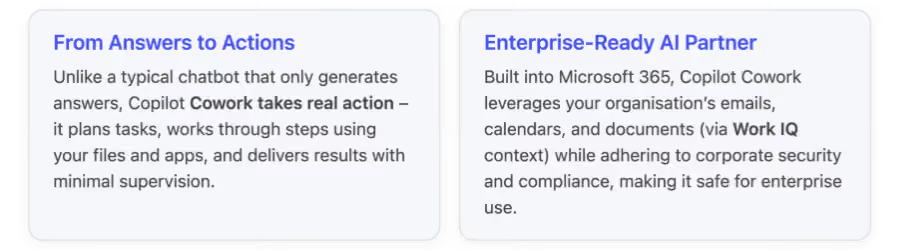
Copilot Cowork is an AI assistant that you can delegate work to, as if it were a capable team member. You describe the outcome you want, and Cowork generates a step-by-step plan, uses the necessary tools (like Office apps, calendars, email) and data to execute each step, and then presents the outcome.
For example, if you ask it to “prepare next week’s client update presentation,” Copilot Cowork can gather information from your emails and documents, draft slides in PowerPoint, schedule prep meetings on your Outlook calendar, and collate any relevant Excel stats, all while keeping you informed and allowing you to adjust the plan.
This agentic (“autonomous agent”) approach means Copilot Cowork isn’t just answering questions, it’s carrying out tasks on your behalf. It works within the Microsoft 365 cloud environment, drawing on Microsoft’s Work IQ intelligence layer (which aggregates your work data like mails, chats, files, and meetings) to provide rich context.
As a result, Copilot Cowork can do things like prepare a client meeting briefing by cross-referencing your recent email thread with that client, pulling data from a shared spreadsheet, and even blocking time on your calendar for preparation. This depth of integration into your work life is something a standalone AI agent (like a local app) can’t easily replicate.
Notably, Microsoft built Copilot Cowork in close partnership with Anthropic, the AI company behind the Claude model. In fact, the underlying AI brain of Copilot Cowork is Anthropic’s Claude, integrated directly into Microsoft 365 Copilot’s infrastructure. Microsoft opted to collaborate instead of creating a new model from scratch after investing in Anthropic in late 2025, so it could bring Claude’s advanced capabilities into the enterprise setting quickly. Jared Spataro, Microsoft’s AI at Work chief, put it plainly: “What Anthropic has done is demonstrate the value of these agentic capabilities. Microsoft is all about commercialization.” In other words, Anthropic showcased the concept of an AI co-worker, and Microsoft scaled it for business use, leveraging its secure cloud, huge user base, and deep integration in workplace tools.
Key Features and Capabilities
Copilot Cowork introduces a range of powerful features aimed at making knowledge work more efficient and innovative:
- Autonomous Multi-Step Workflows - “Agentic” AI is the core of Cowork. You can delegate complex or repetitive workflows, and it will handle them from start to finish. It breaks your request into sub-tasks, executes them in sequence (or even in parallel when possible), and checks in if it needs guidance. For instance, if tasked with organizing a project kickoff, Copilot Cowork might create a project plan, draft an agenda in Word, schedule a Teams meeting with invitees, and set up a SharePoint folder for shared files doing in minutes what might take you hours.
- Contextual Intelligence via Work IQ – Because it’s built into Microsoft 365, Copilot Cowork has native access to your work context: your Outlook emails, Teams chats, OneDrive files, calendars, and more. It uses this Work IQ knowledge to make smarter decisions. For example, when drafting a document or email on your behalf, it can pull relevant facts from recent files or conversations. When scheduling or coordinating, it knows your real calendar availability and deadlines. This means the output is highly tailored to your actual work environment and team, which standalone AI tools can’t match.
- Multi-Model Collaboration (Claude + GPT) – Uniquely, Microsoft 365 Copilot (and the Cowork agent) takes advantage of more than one AI model to improve quality. Copilot Cowork can use OpenAI’s GPT for content generation and Anthropic’s Claude to review or refine the results, a feature called “Critique.” In Microsoft’s research agent tests, this two-model approach achieved a 13.8% higher deep-research accuracy score (DRACO benchmark) than a single-model answer. In practice, this means you get more accurate and well-rounded outputs – for example, a detailed analysis report written by GPT might be double-checked by Claude for factual accuracy and completeness before you see it1. Copilot can even display a Council of multiple model responses side-by-side for comparison, so you get the benefit of diverse AI “opinions” on complex problems.
- Seamless Microsoft 365 Integration – Copilot Cowork works across the apps you use every day. It can create or edit documents in Word, build slides in PowerPoint, analyze data in Excel, extract action items from Teams meeting transcripts, send emails via Outlook, and more, all through the same interface. In a demo, Microsoft showed Cowork automatically compiling a competitive analysis report by pulling information from meeting notes and customer data, outputting a Word doc and a supporting Excel sheet with charts. Because it operates inside the M365 apps, the formatting and file compatibility are taken care of your AI-generated content arrives in the tools you’re already comfortable with.
- Enterprise-Grade Security & Compliance – Designed for corporate environments, Copilot Cowork runs within your organization's secure Microsoft 365 cloud, so it respects all your established permissions, data governance, and auditing rules. Every action the AI takes whether it’s accessing a document or sending an email on your behalf it is logged and auditable by IT. Any files it creates or modifies are stored in your company’s secure cloud, with the usual access controls. This is a critical differentiator from local AI agents: for companies in regulated industries or with strict compliance needs, Copilot Cowork provides the transparency and control required to trust an AI with real work.
- Built-in “Skills” and Tool Integrations – Copilot Cowork comes with specialized capabilities (Microsoft calls them skills) to handle common tasks. For example, it has a calendar management skill to intelligently schedule or rearrange meetings (accounting time zones, availability, etc.), and a daily briefing skill that can summarise your day’s priorities. It can tap into the Microsoft Graph to retrieve contacts or past communications. Over time, Microsoft is likely to add more such skills (and allow custom ones), so the AI can interface with third-party tools or internal systems, further extending what tasks it can automate.
How Copilot Cowork Boosts Productivity and Innovation
For innovation teams and leaders, Copilot Cowork can be a gamechanger. By offloading routine and multi-step chores to the AI, teams can spend more time on creative, high-value work. Here are a few ways Copilot Cowork enhances productivity in collaborative and creative environments:
- Accelerating Project Workflows: Tedious project tasks like gathering status updates, scheduling meetings, or assembling reports can be handed to Copilot Cowork. For example, an innovation lead could ask, “Summarize this quarter’s R&D experiment results and prepare a slide deck with key findings.” Copilot Cowork will fetch data from the related documents and emails, generate a summary report, and draft slides complete with charts in PowerPoint. The team can then focus on refining strategy and brainstorming ideas, rather than crunching numbers and copy-pasting info.
- Enhanced Meeting Preparation: In collaborative work, a lot of time goes into meeting prep and follow-ups. Copilot Cowork shines here by digging through your organisational knowledge to prepare you for meetings. If you have a brainstorm scheduled, you can instruct Cowork: “Gather all recent customer feedback and product improvement ideas from our team chats and create a brief for the meeting.” It will scan your Teams channels and emails for relevant input and present a concise brief. After the meeting, you could ask it to compile action items and even draft follow-up emails. By doing heavy lifting, the AI frees everyone to concentrate on the creative discussion during the meeting, rather than on note-taking or clerical work.
- Continuous Planning and Coordination: Copilot Cowork can serve as an ever-ready project coordinator. For instance, innovation teams often run recurring processes (like monthly innovation reviews or budget planning cycles). Cowork can automate these repeatable workflows for a “monthly innovation portfolio review,” it could automatically pull the latest metrics from Excel, draft an updated report, and send calendar invites for review meetings every month. It ensures nothing falls through the cracks, and that processes run on schedule, with minimal manual effort.
- Cross-functional Collaboration: Because it operates with an awareness of shared files, team calendars, and group chats, Copilot Cowork can help connect dots between different team members’ work. Suppose the design team, engineering team, and marketing team are all working on a new product launch. Copilot Cowork can aggregate insights from each team’s files and chats to generate a combined update or to identify inconsistencies and information gaps in the plan. This not only saves time in chasing information but can also reveal insights that spark new ideas (for example, spotting a recurring customer concern in supporting tickets and bringing it to the product team’s attention).
- Example Early Adopter Success: One early adopter, Capital Group, reported significant benefits from Copilot Cowork. Their teams used it for planning, scheduling, creating deliverables, and preparing executive reviews, all within their secure Microsoft 365 environment. Barton Warner, SVP of Enterprise Tech at Capital Group, highlighted that Cowork isn’t just about generating text, “it’s about taking real action connecting steps, coordinating tasks, and following through across everyday workflows.” Equally important, he noted that because the AI works on their enterprise data within established security boundaries, they can “experiment, learn, and scale with confidence,” focusing on where AI truly adds value. In short, Copilot Cowork let their people move faster on innovation projects by handling the busy work reliably in the background.
Copilot Cowork vs. Anthropic Claude Cowork
Microsoft’s Copilot Cowork emerged very shortly after Anthropic’s Claude Cowork, and at first glance these two “AI coworkers” sound similar – both use Anthropic’s Claude model and both can execute multi-step tasks. However, they are built for different contexts and users. Here’s how they compare:
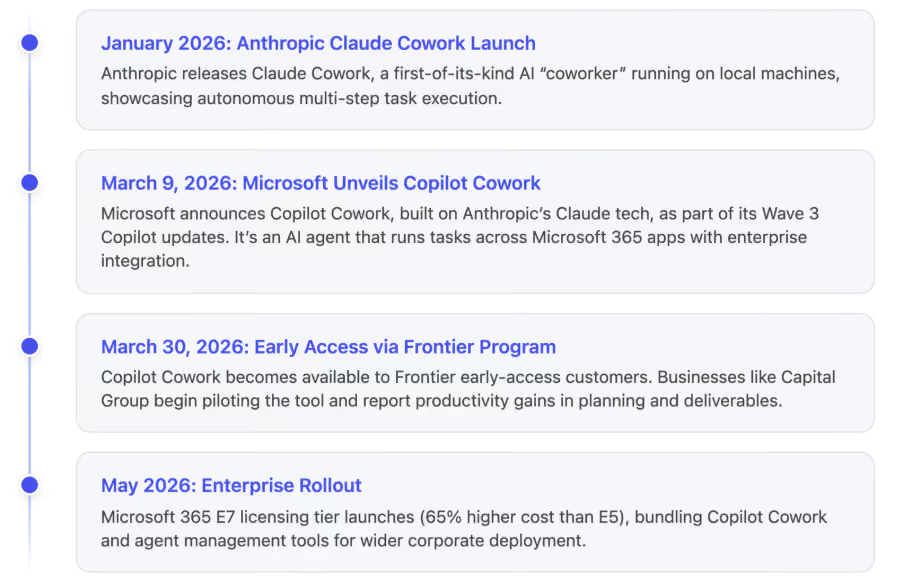
- Origins and Approach: Anthropic was first to debut the AI co-worker concept with Claude Cowork in January 2026, as a standalone desktop agent. It amazed many by showing an AI could perform lengthy, tool-using tasks on a PC. Microsoft’s response in March 2026 was not to compete directly, but to partner with Anthropic. Microsoft integrated the Claude cowork technology into its own Copilot product, essentially wrapping Claude’s capabilities inside the Microsoft 365 cloud environment. So under the hood, both tools leverage the same AI engine (Claude) for reasoning, but Microsoft adds its multi-model orchestration and enterprise integration on top.
- Integration and Environment: Claude Cowork runs locally on your device. This means it can, in theory, work across any application you have, giving it a lot of flexibility for individual power users. You don’t need Microsoft 365 at all, it’s an independent app. However, running locally also means it lacks built-in access to cloud-based organizational data. It can’t natively tap into a company like SharePoint or your team’s Exchange calendar because it operates outside that cloud ecosystem. Copilot Cowork, by contrast, lives inside Microsoft 365’s cloud. It’s deeply integrated with Office apps and leverages your company data (with permission) emails, SharePoint files, Teams channels, calendars via Work IQ. This makes it extremely powerful for enterprise use, because it operates with full awareness of your organizational context (something a local agent can’t achieve).
- Collaboration and Use Cases: Both tools can handle similar categories of tasks for example, calendar management, drafting documents, doing competitive research, preparing meeting summaries, and coordinating multi-document workflows. The big difference is who they serve. Claude Cowork is tailored more to individuals (developers, researchers, or small teams) who want an AI helper on their personal machine without corporate strings attached. It’s great if you’re a solo operator or a startup techie who needs an AI to automate tasks across various local apps (maybe coding, web research, file operations) and you don’t need it to know about an enterprise network. Copilot Cowork is built for enterprise teams already using Microsoft 365. Its sweet spot is in scenarios where multiple colleagues, shared cloud data, and organizational processes are involved exactly where having that enterprise context “pulls ahead for enterprise users”. For example, coordinating a cross-department project or generating a brief that draws on company-wide information is where Copilot Cowork excels, whereas Claude Cowork in those cases would be limited by only local data.
- Security and Governance: Because Claude Cowork runs locally, it inherently has limited oversight or governance there’s no automatic record of what it accessed on your machine or what it did, which might be acceptable for personal use but is a red flag in big organizations. In fact, any sensitive data it handles isn’t centrally tracked. Copilot Cowork, on the other hand, is cloud-based and auditable by default: all actions it takes in your Microsoft 365 tenant can be logged and reviewed. It adheres to your organization’s identity and access controls (only accessing data you’re allowed to) and keeps administrators in the loop. Microsoft even introduced a tool called Microsoft Agent 365 (available as an add-on) that lets IT monitor and manage AI agent activities across the company, set up policies, and catch any risky behavior. None of that structure exists for a local agent like Claude Cowork. For a CISO or compliance officer, this governance is often non-negotiable in enterprise settings.
- Availability and Licensing: Claude Cowork is available through Anthropic’s platform, typically as part of their Claude AI service subscription (with usage-based pricing). It can be used by anyone who signs up, without needing corporate approval. Copilot Cowork is offered to businesses; it requires a Microsoft 365 E5 subscription or the new E7 “Frontier” Suite (an even higher-tier package launching in 2026 that bundles all the AI goodies). In other words, an individual can’t just download Copilot Cowork an organization needs to enable it for their users. It’s currently in early access (via the Frontier programmer) as of March 2026, with broader rollout expected soon.
Below is a side-by-side comparison of Microsoft Copilot Cowork vs. Anthropic Claude Cowork in terms of features, integrations, and use cases:
A New Era of AI-Assisted Work
In summary, Copilot Cowork represents a new era of AI in the workplace moving from passively assisting with information to actively collaborating on real projects and tasks.
It’s like having a super-skilled assistant who can work at digital speed, attending meetings, reading documents, and producing drafts in parallel, all orchestrated under your guidance.
For innovation leads and forward-thinking teams, this means more time to innovate: the AI takes care of preparation and execution, while humans focus on creativity, strategy, and fine-tuning the results.
Meanwhile, Anthropic’s Claude Cowork shows another side of this evolution: a more open-ended AI agent for individual use, demonstrating what’s possible when an AI can control a computer like a human assistant would. Microsoft’s approach, however, is to bring that power into the everyday tools of business in a governed, scalable way.
By teaming up with Anthropic, Microsoft essentially turned a cutting-edge concept into a product that companies can deploy with confidence.
Conclusion
In a world where innovation and speed are paramount, tools like Copilot Cowork offer a significant edge. By handling the busywork researching, compiling, organizing, cross-checking, this AI frees human teams to concentrate on creative problem-solving and big-picture thinking. At the same time, its integration into the Microsoft 365 suite means it works where you work, securely and contextually, rather than being a disconnected novelty.
For organizations already invested in Microsoft’s ecosystem, Copilot Cowork can amplify productivity across departments. Imagine product managers, engineers, and designers all benefitting from an AI that coordinates their inputs and keeps the project in sync, or an innovation lab where ideas progress faster because the AI continuously gathers insights and takes care of follow-ups.
As AI coworkers become more common, we’re likely to see heightened collaboration between humans and AI. Microsoft Copilot Cowork and Anthropic Claude Cowork are early exemplars of this trend, one optimized for the enterprise, the other for individual power users. Both underline a shift from AI as a tool you consult, to AI as a partner that actively participates in the work.
For innovation leads, that means an exciting opportunity to reimagine workflows: routine tasks can be offloaded, and human talent can be re-focused on innovation itself. In essence, Copilot Cowork lets your team spend less time juggling tasks and more time driving innovation forward.
faqs

Venkatesh Maran

Founder and CEO of SharePoint Designs, a Microsoft ISV with 6 products live on AppSource. We build products that solve the problems Microsoft left on the table. Intranets that people actually use. Document management systems that don't fight your workflows. Knowledge platforms that surface what matters. And now, AI agents built on Microsoft Copilot that take the repetitive work off your team's plate. Every product we build gets designed around your brand, your culture, and how your teams actually work. Trusted by enterprises across 23 countries, primarily in the US and Europe, with deep expertise in SharePoint, Power Platform, Microsoft Copilot, and Microsoft 365. Over 15 years in the ecosystem and still going. Our mission is simple: make work more fun.





.svg)